

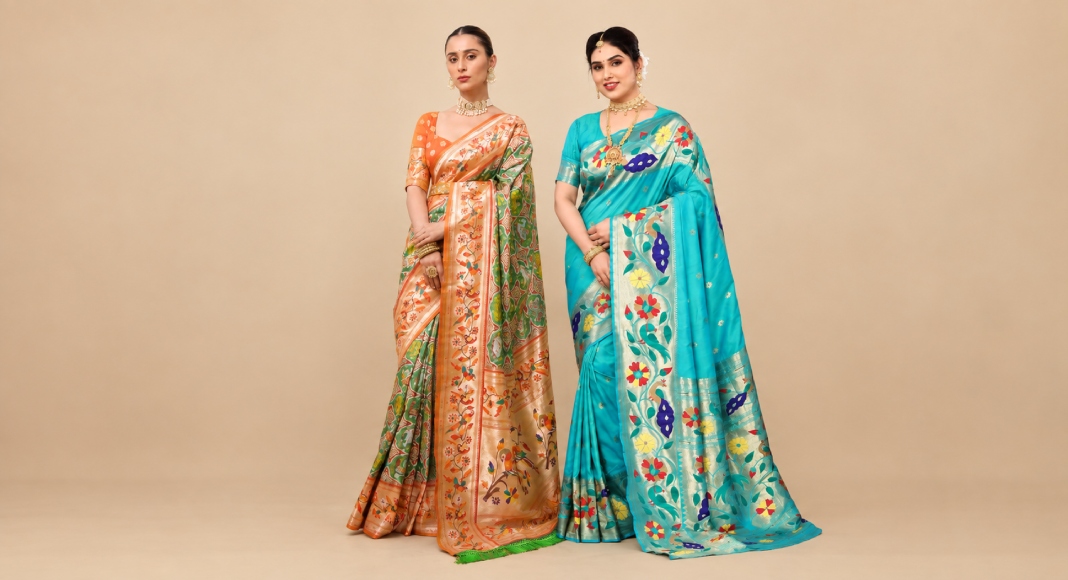
Every Maharashtrian household has that one saree tucked away in silk paper, waiting for the right occasion. More often than not, it’s a Paithani saree. Mothers hand it down to daughters, and sometimes it skips a generation before it’s worn again at a wedding or a big family function. This isn’t just another piece of clothing. It carries generations of weaving skill, and it still holds its place as the most celebrated of all Maharashtrian sarees. Even women who own dozens of sarees will still reach for their Paithani first when a major festival comes around, because nothing else quite matches its weight and history. If you’re planning your festival wardrobe this year, here’s how to actually wear one well.
What Makes a Paithani Saree Different
A genuine Paithani is woven, not printed. The pallu usually carries a peacock motif, and the border is thick with zari work done in real gold or silver thread. This is what separates it from ordinary traditional silk sarees. The weaving process alone can take weeks, sometimes months, depending on the complexity of the design. That’s a big part of why it costs what it costs, and why it’s treated as an heirloom rather than a one-time buy.
If you’re shopping online, look closely at the pallu and border before you decide. A good Indian saree retailer will show you close-up shots of the zari work and the weave pattern, not just a full-length photo from a distance. That detail tells you everything about the quality you’re paying for.
Styling for Gudi Padwa
Gudi Padwa calls for something bright. Go with a Paithani in a bold color combination, maybe a deep green paired with a red or maroon border. Festivals like this call for a saree that photographs as well as it feels, and this is exactly that kind of piece. Pair it with a nauvari-style draping if you’re comfortable with it, or stick to the standard Nivi drape if that’s easier for your day. Either way, keep your blouse simple. A plain silk blouse in a contrasting color lets the saree’s border and pallu do the talking. Don’t compete with the weave; let it lead.

Styling for Ganesh Chaturthi
Ganesh Chaturthi is louder, more festive, more crowded with rituals and guests. This is where you can afford to go heavier on the jewelry. A Maharashtrian jewelry set works beautifully against the muted gold tones of a Paithani. Think a nath, a mundavalya-style hairpiece, or a kolhapuri saaj.
If your saree already has a busy zari border, keep the neckline of your blouse simple, but don’t shy away from a statement necklace. This is a day for traditional jewelry that feels substantial, not delicate. Gold-toned pieces, even ones with a slightly antique finish, sit well against the silk.
Styling for Diwali
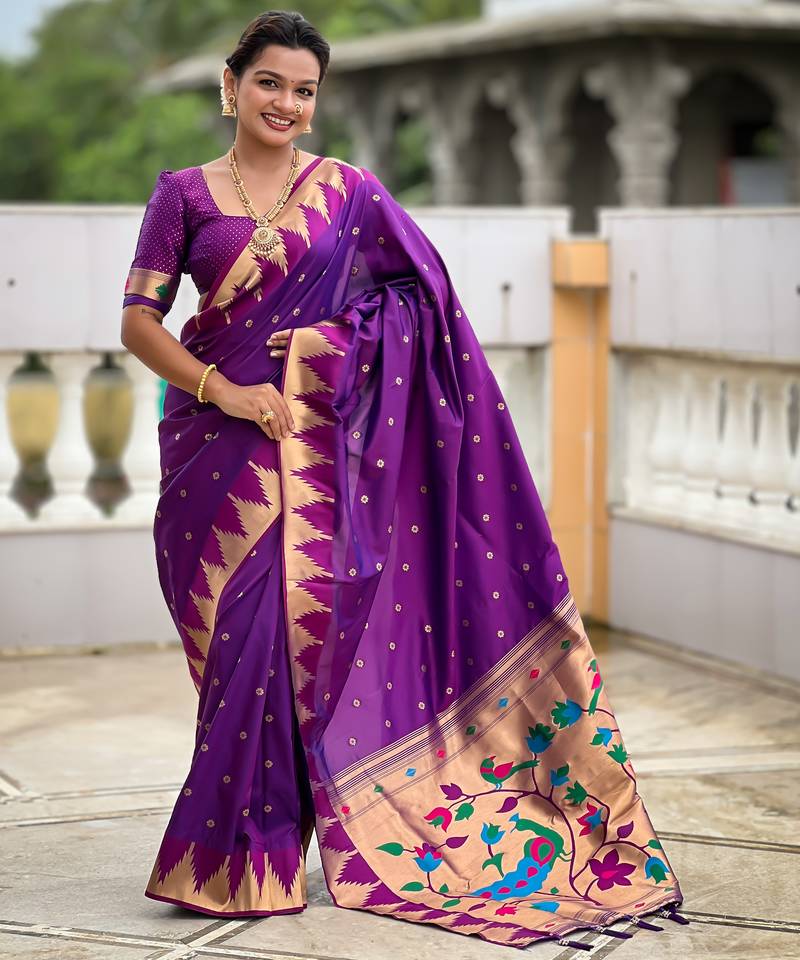
Diwali gives you more room to experiment. This is a good time to try one of the newer designer sarees styles, Paithani with contemporary blouse cuts, or a fusion drape that keeps the traditional weave but modernizes the silhouette. A boat-neck or a deep V-back blouse in raw silk can update the whole look without taking away from the saree itself.
Designer blouses with mirror work, small embroidery, or piping details pair especially well with plain-bordered Paithanis. If your saree has a heavily worked pallu, though, keep the blouse minimal. Two loud elements will fight each other, and neither will look as good as it could alone.
Choosing the Right Blouse and Jewelry Combination
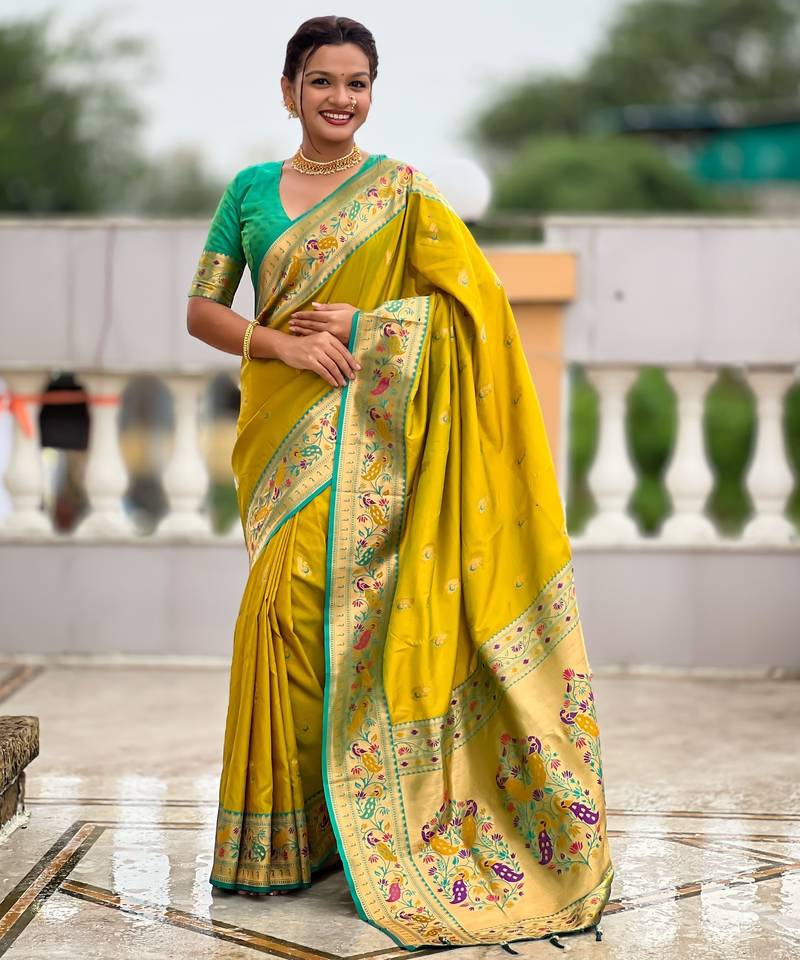
The general rule with Paithani sarees is balance. If the saree is loud, keep the blouse and jewelry quiet. If it’s more subdued, in a lighter shade with a thinner border, that’s when heavier traditional jewelry or a detailed blouse works.
For everyday festival wear, a simpler drape works fine. Save elaborate hairstyles and heavy jewelry for Gudi Padwa and Ganesh Chaturthi. For smaller pujas, a Paithani with minimal jewelry and open hair looks just as appropriate, and more comfortable for a long day.
Building a Festival Wardrobe
Don’t buy five sarees in the same color family. A good wardrobe needs a variety of sarees. Mix up your base colors, border widths, and motifs, some with peacocks, some with simpler geometric patterns. This gives you options depending on the festival and the venue.
Mirraw carries a wide range of traditional sarees for women who want authentic weaves without traveling to Paithan or Yeola. Whether you’re after a classic traditional saree silhouette or something modern, the right piece comes down to knowing which festival you’re dressing for.